When Do You See Wheaty Again Portal 2

Portal 2
This item has been removed from the community because information technology violates Steam Community & Content Guidelines. It is only visible to you. If you believe your particular has been removed by fault, delight contact Steam Support.
This particular is incompatible with Portal 2. Delight encounter the instructions folio for reasons why this item might non work within Portal ii.
Electric current visibility: Subconscious
This item will just be visible to you, admins, and anyone marked as a creator.
Electric current visibility: Friends-only
This item will only be visible in searches to yous, your friends, and admins.

183 ratings

Building High Quality Maps in Portal 2
A short guide on how to design great, fun, and challenging Portal two maps. Only the theory of design is covered in this guide. Please refer to other online guides if you would like to learn how to employ the PeTI or Hammer.
Introduction
How-do-you-do and thank y'all for reading (or at least clicking on) my guide for Portal 2.
I am an avid Portal 2 thespian (as if my it wasn't already clear from my profile) and I have played thousands of community-fabricated Portal two maps.
My experiences have been mixed. I've played maps that take been fantastic, absolutely abysmal, and everything in betwixt. I would like to put forward my feel over these years so that map designers may generate higher quality maps.
Let me start off by saying that I am, past no means, an experienced map designer. On the reverse, I do not pattern very many maps myself, just I exercise dearest playing them. I know what I like nearly maps and I know what I don't like. So in effect, this guide is fabricated upwardly of primarily my opinions about community maps, simply I still do promise that information technology does influence the way you choose to pattern maps in the hereafter if yous e'er do so.
So, without farther ado, permit'south begin!
TL;DR: Hi
The "Leave Solution"
"How do I go from the entrance to the go out?"
I refer to that as the "Exit Solution" of the map. You can think of it as the underlying purpose of the map. Examples include (merely are not limited to):
- Simply reaching the exit because it is on a ledge or other unreachable place
- Placing a cube on a receptacle then that it unlocks the door
- Using a light amplification by stimulated emission of radiation beam to hit a receptacle so that it unlocks the door
Understand that this does not mean that getting to the exit is the simply matter you demand to do. In fact, about maps volition require you to solve a number of puzzles earlier you tin leave the map. And then, why practise I bring this up?
Some maps are desperately designed in the sense that yous do not know where the exit information technology. Here's an case of one where the Exit Solution is not articulate correct from the very start:
http://steamcommunity.com/sharedfiles/filedetails/?id=68513974
Virtually map designers get around this problem by having the exit placed in manifestly view from the archway. As soon every bit yous enter a map, y'all run across the exit and y'all know "That's where I need to get to". For instance:
http://steamcommunity.com/sharedfiles/filedetails/?id=119534466
Of course, the rule of putting the leave in plain sight of the entrance is not set in rock. As long as y'all're careful with the map pattern, y'all tin become away with a slightly linear map like this:
http://steamcommunity.com/sharedfiles/filedetails/?id=88889837
TL;DR: I need to know where the exit is and (if applicative) what needs to be done to open the go out door. I'll figure out the residuum of the puzzle myself.
Puzzle Linearity
For those that do not understand what puzzle linearity is, I retrieve it is best to explain it in terms of a sequence of puzzles to solve. Most maps will require you to solve more than one puzzle. If a map is cleverly designed, you can solve those puzzles in any club that yous wish (even re-using some puzzle elements). However, less idea-out maps volition require y'all to solve a puzzle first, then move on to the adjacent, etc. This is an example of a map that is linear:
http://steamcommunity.com/sharedfiles/filedetails/?id=68474166
Once the first part of the puzzle is solved, the balance of the map literally collapses into a job to complete it considering the challenge element is gone. Nonetheless, maps practice non need to be small to be linear. Accept a look at this ane:
http://steamcommunity.com/sharedfiles/filedetails/?id=73090593
It is a massive map, but still... puzzle elements need to exist solved in the correct order if you want to consummate the map.
The case of "The Bully Glass Elevator" is an interesting one. There are four "puzzles" to solve, each intertwining with the other. This map could simply be dissever into four separate maps, making the chamber a lot more fun, easy to grasp merely nevertheless maintain its level of difficulty.
But beware! Making a map not-linear can cause a lot of problems. Players tin can feel lost, not sure what to do next. For example:
http://steamcommunity.com/sharedfiles/filedetails/?id=125214103
The map is huge, and not-linear. Puzzles tin can be solved in (almost) any order to still complete the map. What this ways for showtime-fourth dimension players is a lot of confusion every bit to where to become next.
Of class, linear maps practice non always hateful they are boring. Some can be fun to play, even if they do non really pose a challenge. A skilful instance of this is the creative apply of test elements. A squeamish example of this is as follows:
http://steamcommunity.com/sharedfiles/filedetails/?id=91703348
Now, it is of import to note that ChickenTest is a Hammer-made map. Still, I believe that fun, creative maps can also be made using the PeTI. All you need to do is think upwards of artistic ways to use test elements. The goal of a map designer is to carefully balance the map in terms of linearity, and so that the actor is guided as to where to get, merely non spoon-fed the solution.
TL;DR: Beware of linearity in your maps. Very linear maps tin can exist irksome (but not always!), only non-linear maps can be confusing.
Size Does Matter
Have care with the size of your maps. Do non make them unnecessarily big. Why? Well, for one, running back and forth between puzzle elements can become irritating later some time, especially if at that place are no portalable surfaces, or if your portals are locked on other surfaces in order to solve the puzzle.
For example, here is a sleeping accommodation that is unnecessarily large:
http://steamcommunity.com/sharedfiles/filedetails/?id=108978668
Fifty-fifty though the Aerial Faith Plates have been provided, the map could be trimmed down to about half its electric current size by connecting the two sides in a clever manner.
The other farthermost is making a map too small. A small map can feel very cramped. Add a little infinite and so the role player does have a sense of liberty of move. That is, unless a tiny map is what you are going for:
http://steamcommunity.com/sharedfiles/filedetails/?id=85201742
Again, it's a careful residuum that is required to brand certain test chambers feel just right.
TL;DR: Make sure your chambers are appropriately sized. Non also small and then that it feels cramped, but not too big with unused space.
Wall Blueprint and Unintended Solutions
When building your puzzles, make sure to have the blazon of wall panels you are placing into consideration. Wall panels can either be portalable or non, and they are critical to ensuring a player solves this puzzle through the intended solution.
Maps which practise not take wall panels into consideration will open themselves upward to unintended solutions. For example:
http://steamcommunity.com/sharedfiles/filedetails/?id=137814897
You can fix this trouble past making wall panels united nations-portalable. Or, if you're even more creative, use drinking glass walls:
http://steamcommunity.com/sharedfiles/filedetails/?id=129438874
I wouldn't worry too much nearly people cheating to solve the map. Possible methods of cheating include:
- Bunny-Hopping: Jumping constantly while moving forward allowing you to get to places which would be otherwise impossible to get to. You might meet me do this in some of my videos, merely never to cheat a map. I merely employ it to become from point A to point B faster.
- Portal-Bumping: Placing a portal very close to another, causing the newly-placed portal to "crash-land" over and reach an otherwise un-portalable location.
If someone wants to cheat, in that location really is no mode of stopping them, because they can simply noclip the map. Simply remember, y'all are non catering your map for cheaters. In that location are people that genuinely relish a challenging map, and you volition receive appreciation for that.
As an example, here is a simple map that I have created. The portalable panels ruin the puzzle and nullify the purpose of the push button and cube, considering you lot tin simply portal over the go out:
http://steamcommunity.com/sharedfiles/filedetails/?id=164529409
This tin be fixed with proper wall panels:
http://steamcommunity.com/sharedfiles/filedetails/?id=164529709
TL;DR: Brand sure unintended solutions do not occur because you haven't taken time to call up about whether portals can be placed on your wall panels.
Ninja-skills
This volition probably be the single-most department to crusade the greatest disagreement in the comments, but let me come up out with it direct off: maps that crave intricate and perfect levels of timing are not considered challenges, just annoyances.
Portal is a puzzle game. It is a game that should require thought in order to solve a puzzle. Once someone knows how to solve a puzzle, the execution should be easy and painless. Apparently, some people practise not agree with this idea and have generated maps that aren't especially difficult to solve puzzle-wise, simply are almost-to-incommunicable to solve timing-wise. Here's an example of one of those maps:
http://steamcommunity.com/sharedfiles/filedetails/?id=89956472
Even subsequently you take figured the map out, the execution is near-to-impossible. It is of import to notation that I am not maxim timed elements are useless in a map. On the contrary, you may demand to have timed elements (a portal-able panel that's only open for a certain amount of fourth dimension) in order to straight a actor towards a sure solution. But do not design a map where the element of timing is critical to solve it (ie. the execution has to be perfectly timed to solve the puzzle). Requite them a little slack for fault!
Make provisions to ensure that fifty-fifty if the timing is off, the thespian does not need to solve a small chunk of the puzzle but to reset the position. Here is an instance of a map that does not take this into account:
http://steamcommunity.com/sharedfiles/filedetails/?id=141692493
Once y'all are on the final stage of the solution, if your timing is off, you will need to re-solve office of the puzzle to reset the cube to where it needs to be to solve the final part of the puzzle.
TL;DR: Use timed elements advisedly. Puzzles requiring ninja-skills can get very annoying, especially if the thespian knows how to solve the puzzle.
Death Elements and Respawn
At that place are a number of elements that can crusade the expiry of a actor in a puzzle. These elements include (but are not express to):
- Abysmal pits
- Acid Pits
- Crushers
- Turrets
- Laser Fields
If you do choose to use such elements in your puzzle, please prepare upward car-saves in the puzzle every bit the histrion progresses through the chamber. Yes, I practice know about F6, the magic auto-save key. Only here'due south the trouble: when you blueprint a level that'south skilful enough, it will immerse the actor in the puzzle. Having the player remember "await, I should probably save my game correct now" every footstep of the mode takes the actor out of this experience and ruins the fluidity of your chamber.
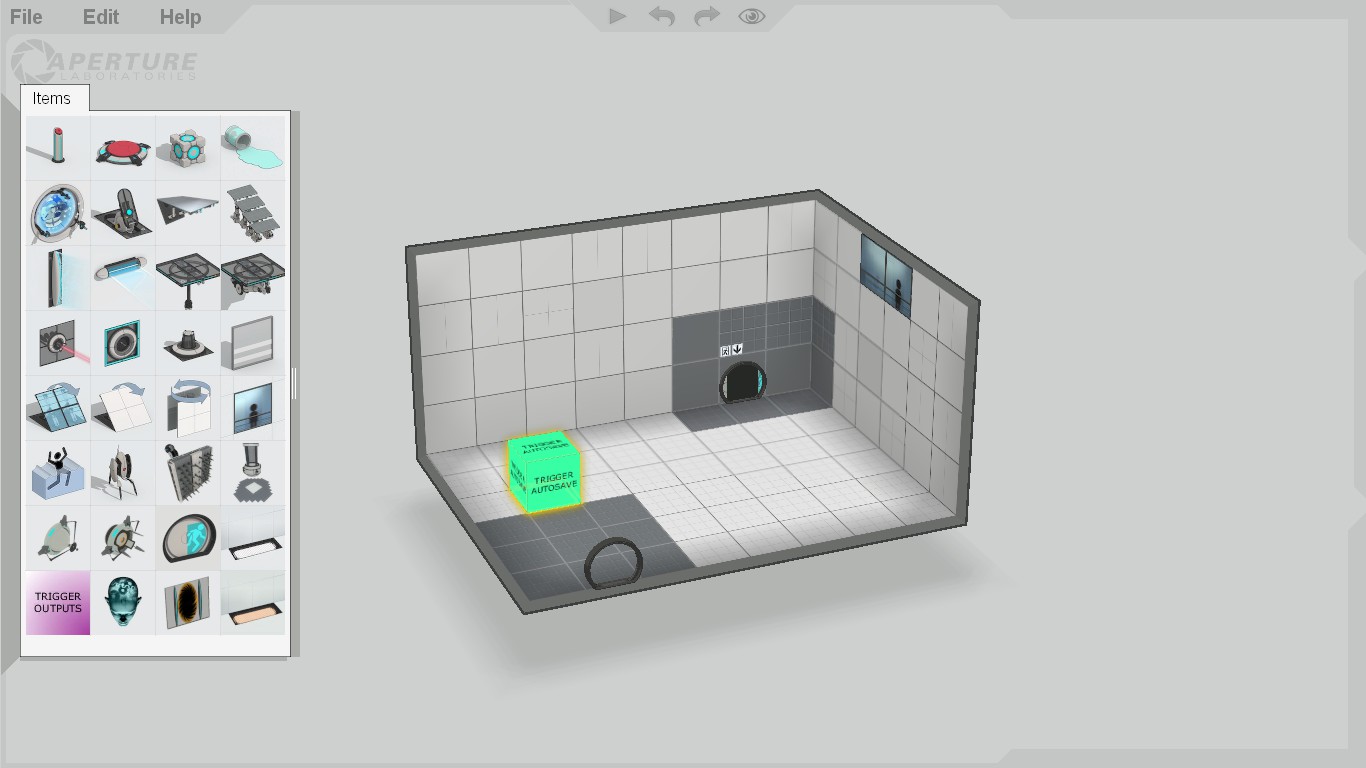
For PeTI, you may be forgiven until I mention BeeMod[portal2backstock.com], which is a fantastic improver for Portal two. It enhances your PeTI Test Chamber Architect with a lot of actually nice elements, including the most-wanted autosave.
So at that place you accept information technology. Automobile-saves! Because there is nil worse that going through a brutal exam sleeping room, only to die and get respawned at the start.
Decease elements should exist used sparingly. An important principle in map design is to ensure that if a player was to die, they did something wrong. Never impale a thespian off in a map as a "surprise". Use death elements to punish a player for making the wrong choices. An example is in the map below:
http://steamcommunity.com/sharedfiles/filedetails/?id=150822870
Around half-mode through the map, temptation may atomic number 82 a player to apply their momentum to fling propel themselves off the angled console (and land into the pit). Death elements like these are well-placed.
Also, ensure that your players cannot get trapped in a sure office of a map without portal-able surfaces to get them out (for example, in a deep pit). Yous can use death elements or place portal-able surfaces to solve this problem.
On the bailiwick of respawns, if y'all do have maps which contain several stages too as death elements, make sure that the player is able to go back to where we left off, without having to solve the phase all once again. For instance, if a map was made up of three sub-sections and a player were to die on the second, do not brand them solve the first section all once more. With a little trigger-work, information technology's not difficult to do, and volition get a long way to earn a histrion's respect. Here's an case of a map which does so perfectly:
http://steamcommunity.com/sharedfiles/filedetails/?id=111709139
TL;DR: Auto-saves are your friend. Too, make sure a histrion can go back to exactly where they died, without having to solve the entire map all over again.
"But I might need it later"
If y'all do use cubes, spheres or other movable elements in a map, make certain that they all have a purpose. But more importantly, if you have a multi-stage map, make certain that they cannot exist moved from one phase to another (unless that is intended). That is, ensure that all cubes that can exist moved to the finish of the map are doing something to allow you to exit the level, even if it means placing them on a receptacle which will open the exit door. This map serves as a skillful example:
http://steamcommunity.com/sharedfiles/filedetails/?id=119397726
The cubes have other uses in the map, merely at the stop, all cubes need to exist brought to unlock the exit door.
Some maps have cubes which tin can be brought to the end, merely to find that they accept no purpose! The other extreme is actually getting to the stop of the map, but to find out that you lot need a cube that you lot left at the very start.
The easiest way of solving this issue is by the utilize of Fizzlers. If a cube should not be moved between sections of the chamber, put a fizzler in the way. That will convey a clear message to the histrion that the cube has to stay where it is.
Think, Portal is a logic puzzle. All puzzles should be solved using logic (and a trivial trial and error). As soon as your chambers become guessing games, you reduce the overall quality of the map.
TL;DR: Ensure that by the end of the map, all cubes have had and still take a purpose. If a cube does not need to be brought to the end of the map,make certain you add together Fizzlers or fix up the puzzle in such a way that the cube needs to stay where it is.
Red Herrings
While nosotros are on the subject of guessing, let'south talk about Red Herrings. Cherry herrings are little elements that take been added to maps that serve no purpose. They are there to fob the player into thinking that they do something, when in theory, they do not.
I'yard happy to say that in my Portal-playing career, I have not encountered a single map with Ruby Herrings. Of course, I accept seen maps with Companion Cubes backside drinking glass walls inside a sealed room for decorative purposes, simply those were clearly for ornament.
Call up, decorating your map with some elements is fine, as long as yous brand it really obvious that they serve cypher just artful purposes.
TL;DR: Make sure everything has a purpose! Red Herrings are a definite no no!'
Hammer, Decorations and Center-Processed
Hammer is an incredibly powerful tool that you tin use to make maps that await very different to maps that are made using the PeTI. Of course, there is a learning bend associated with the utilize of Hammer.
The other advantage of Hammer is the ability to 
Making a map aesthetically pleasing is non a priority for a lot of map developers, and nor it should be. The fundamental aspect that sets a map autonomously from the rest is the claiming information technology poses. Simply, if you lot would like to add together eye-candy to a map to make it await ameliorate, by all means, go ahead and practise then!
Likewise, with regards to the new and upcoming BeeMod ii[portal2backstock.com], you might be tempted to spam the new elements in your maps. Be very conscientious when doing and so equally it can misfile the player. For example, in that location are several new types of Fizzlers that you can place using this mod. Doing so can cause defoliation for the actor equally they volition forget what each kind of Fizzler does.
As a full general dominion, e'er introduce a single element in your map and stick to it. Let it be the main focus of your map. Remember, confusion does not equal a challenge.
TL;DR: Eye processed is nice, but non a must-have.
Pointless Maps
When I open up a map in Portal, I expect a puzzle that volition challenge me. I accept seen a flood of maps in the Workshop that have no puzzle elements. I detect these maps have no reason to be there, because they practice not fit the genre of Portal. Yeah, they demonstrate creative utilise of test elements and triggers, but really, they have no place in the Workshop.
These maps annoy me, only not as much, as I do appreciate how long it would have taken the creator to construct them:
http://steamcommunity.com/sharedfiles/filedetails/?id=71496147
Again, there are ameliorate maze puzzles out in that location. I don't need Portal to generate a maze for me.
These maps annoy me the most:
http://steamcommunity.com/sharedfiles/filedetails/?id=116999778
Yes, conversion gel (the white one), and lots of empty space. There actually is no puzzle aspect to the map. Just coat everything white, pray that the gel hits the right surfaces and repeat the procedure until you've coated an area next to the leave and then you can portal over.
As a personal stance, I don't like the post-obit maps:
http://steamcommunity.com/sharedfiles/filedetails/?id=96685421
Information technology is an unabridged MineCraft skin of Portal two with a few similarities in gameplay betwixt the ii games. Why does this be? Because people like MineCraft. If you are a fan of MineCraft, and so go play MineCraft! I don't need MineCraft maps in Portal 2.
http://steamcommunity.com/sharedfiles/filedetails/?id=78101054
Yeah, Aerial Faith Plates are fun, but they are only fun for around ten seconds. Subsequently you've jumped from i plate to some other for a while minute, the experience is pretty much over. Patently, people practise not think this is the instance and there has been a inundation of RollerCoaster maps in the workshop.
http://steamcommunity.com/sharedfiles/filedetails/?id=140534764
Notwithstanding, it is withal not a puzzle. It is definitely interesting to see Portal two elements used for a race-track, simply that is non what Portal is for. If y'all want to play a racing game, at that place are a ton of games that would serve the purpose a lot improve.
TL;DR: Use Portal elements for what they are designed for: creating puzzle chambers. Not racetracks, MineCraft clones or Rollercoasters. And cut downwardly on the conversion gel!
Exam Elements and their Purposes
It is very important to use the right types of exam elements when you lot take a choice to practise and so. This is particularly important when information technology comes to buttons.


TL;DR: Use the right examination elements (especially buttons/receptacles) for your puzzle.
Lighting
This is a small-scale issue, only sometimes, can be diddled out of proportion. Take a look at the map below:
http://steamcommunity.com/sharedfiles/filedetails/?id=68513974
Yous will find that it is very hard to navigate the map because in that location is no lighting.
For about maps I have played, I have never had a problem. People have washed a squeamish job ensuring there is sufficient lighting. But in the case of the above map, no lighting makes the map virtually-to-incommunicable to traverse.
I would recommend putting lite adjacent to the portal-able surfaces. This makes it easier to meet where everything is, looks more than polished, and sometimes helps for placing a portal more easily. Simply be conscientious how you lot place them. Putting four lights effectually a single portal surface makes information technology hard for the portal to exist placed on that surface.
TL;DR: Use sufficient lighting on your maps so players can come across where they're going.
Post-Publishing Tips
Once you lot have published your Portal 2 map, you are going to get feedback from the community about it. This feedback is the most precious feedback y'all are going to become on your map. People will say they loved information technology, hated information technology, but most importantly, the may mention:
- Unintended Solutions
- Bugs
- Parts they struggled on
Based on this feedback, y'all will need to determine to either change the map, or ignore the feedback. This will allow y'all to farther improve your map past the publishing phase.
Retrieve, more than people volition be able to play your map in a shorter amount of time than anyone in the pre-publishing stage. People have different ways of thinking and may solve your maps differently. This feedback will help you decide if you want to fine-tune your map or not.
TL;DR: Pay shut attention to the feedback you receive on your maps. Some feedback can exist priceless!
Conclusion
I hope that my guide has given yous a little food for thought on your Portal 2 map pattern. I have played many test chambers and I feel that my experience may aid provide valuable feedback to map designers as to what people are looking for in a test chamber.
Most of all, have fun designing your maps. If you aren't having fun making maps, players will very probable not have fun playing them.
Thank you for reading!
TL;DR: Goodbye!
Source: https://steamcommunity.com/sharedfiles/filedetails/?id=164226888
0 Response to "When Do You See Wheaty Again Portal 2"
Post a Comment